 עברית
עבריתתקציר בעברית
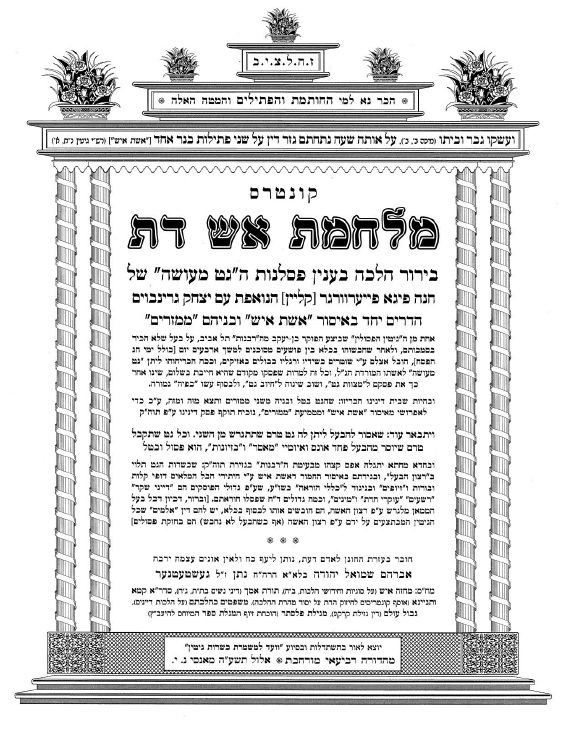
'מלחמת אש דת' היא שו*ת המוססת על גט מעושה שנעשה ב'בית הדין הרבני' של הרבנות תל אביב העוסק בענייני אשה מורדת‚ סמכות הבית דין‚ כפייה במילים‚ וכפייה גמורה ע"י הכלאה עם כל המקורות בהלכה ובפוסקים. 1) שלעניין התיר כפייה אין נפקא מינא בין מאיסות לשינאה. 2) שאין מצוה לתת גט למורדת של 'מאיס עלי'. 3) שאין חיוב גט ב'מאיס עלי' אף כשהם נפרדים לזמן ארוך‚ אפילו בבעלים גרועים. 4) הפרכת המוקורות המזוייפים שיש 'חיוב גט' על 'מאיס עלי'. 5) שאפילו 'חיוב גט' ב'מאיס עלי' פוסל את הגט. 6) שאפילו רק 'עיכוב יציאה' מן הארץ וכל שכן 'מאסר' הן כפיות הפוסלות את הגט במעושה לכל הדיעות. 7) דיחוי מקורות המזוייפים של הרבנות על התיר כפייה ב'מאיס עלי'. 8) שכפייה של בית דין שהבעל לא קיבל סמכותם לא מועילה. 9) אפילו בעל שדינו לכופו‚ אם קיפחוהו מזכויותיו ההילכתיים באופן מתן הגט‚ הוא בטל מן התורה. 10) דיחוי האמתלא דדרך ברירה. 11) דיחוי הטענה שהמאסר לא היה בשביל הגט. 12) הפרכת טענתם דשונא ומורד. 13) שכפייה במקרה של 'מאיס עלי' פוסל אף בדיעבד ואי אפשר להכשירה ע"י ספק ספיקא. 14) ביאור בשיטת הרא"ש והתשב"ץ אם יש להכשיר כפייה בדיעבד. 15) כשהכפייה אסורה עפ"י פוסק אחד הגט פסול מן התורה אף בדיעבד. נספח) שו"ת בדין נשיאה בגט פסול 16) כשהיה לאשה הוראה של היתר נישואין אם היא נחשבת אנוסה. 17) כשיש מחלוקת בין המורים. 18) אם מותר לבעל לתת גט בעודה עם הגבר השני.19) שגם הסוברים במקרה אחר שיגרש‚ יודו לאיסור בנידון דידן. 20) כשהבעל ממאן מליתן לה גט.
English Summary
'Milchemet Esh Dat' is a responsa work based on a case of a coerced Get issued by the state Rabbinical Court of the Tel Aviv Rabbinate. It addresses the laws of the rebellious wife (*Moredet*), the authority of the Beit Din, verbal coercion, and actual physical coercion through imprisonment, with all the relevant sources from the Talmudic and halachic literature. 1) That, with regard to the permissibility of coercion, there is no distinction between *Ma'is Alai* ("he is repugnant to me") and hatred. 2) That there is no mitzvah to give a Get to a rebellious wife claiming *Ma'is Alai*. 3) That there is no obligation to give a Get in a case of *Ma'is Alai*, even after a prolonged separation, and even when the husband is of particularly poor character. 4) A refutation of the spurious sources claiming there is an obligation to give a Get in cases of *Ma'is Alai*. 5) That even merely obligating a husband to give a Get in a case of *Ma'is Alai* invalidates the Get. 6) That even a travel restriction preventing departure from the country—and certainly imprisonment—constitute coercion that invalidates the Get as a coerced Get according to all opinions. 7) A refutation of the Rabbinate's spurious sources permitting coercion in cases of *Ma'is Alai*. 8) That coercion imposed by a Beit Din whose authority the husband never accepted is ineffective. 9) That even where a husband is halachically subject to coercion, if he was deprived of his halachic rights in the manner in which the Get was obtained, the Get is invalid according to Torah law. 10) A refutation of the argument based on *derekh bererah*. 11) A refutation of the claim that the imprisonment was not imposed for the purpose of obtaining the Get. 12) A refutation of the claim that the husband was both hateful and rebellious. 13) That coercion in a case of *Ma'is Alai* invalidates the Get even after the fact, and cannot be validated through a *sefek sefeika* (double doubt). 14) An explanation of the views of the Rosh and the Tashbetz regarding whether coercion may be validated after the fact. 15) That whenever coercion is prohibited according to even a single halachic authority, the Get is invalid according to Torah law, even after the fact. Appendix: Responsa concerning remarriage on the basis of an invalid Get. 16) Whether a woman who remarried pursuant to a rabbinic ruling permitting her marriage is considered to have acted under compulsion. 17) The law where there is disagreement among halachic authorities. 18) Whether the husband may give a Get while the wife is still living with another man. 19) That even those who, in other circumstances, would require the husband to divorce would agree that it is prohibited in the present case. 20) When the husband refuses to give her a Get.
Résumé en français
'Milkhemet Esh Dat' est un recueil de responsa fondé sur un cas de guett contraint délivré par le tribunal rabbinique d'État de Tel-Aviv. Il traite de la femme rebelle (Moredet), de l'autorité du Beth Din, de la contrainte verbale et de la contrainte par emprisonnement, avec toutes les sources halakhiques et des décisionnaires. 1) Qu'il n'y a aucune différence, quant à la permission de contraindre, entre Maïs Alaï et la haine. 2) Qu'il n'existe aucune mitsva de donner un guett à une femme rebelle invoquant Maïs Alaï. 3) Qu'il n'y a aucune obligation de donner un guett en cas de Maïs Alaï, même après une longue séparation, et même si le mari est de mauvais caractère. 4) Réfutation des sources erronées prétendant qu'il existe une obligation de guett en cas de Maïs Alaï. 5) Que le simple fait d'imposer un guett dans un cas de Maïs Alaï invalide le guett. 6) Que même une interdiction de quitter le pays, et à plus forte raison l'emprisonnement, constituent une contrainte invalidant le guett selon toutes les opinions. 7) Réfutation des sources invoquées par le Rabbinat pour autoriser la contrainte dans les cas de Maïs Alaï. 8) Que la contrainte exercée par un Beth Din dont le mari n'a pas accepté l'autorité est sans effet. 9) Que même lorsqu'un mari est, en principe, sujet à la contrainte, si ses droits halakhiques ont été lésés lors de la remise du guett, celui-ci est nul selon la Torah. 10) Réfutation de l'argument du derekh bererah. 11) Réfutation de l'argument selon lequel l'emprisonnement n'avait pas pour but d'obtenir le guett. 12) Réfutation de l'argument selon lequel le mari serait à la fois haineux et rebelle. 13) Que la contrainte dans un cas de Maïs Alaï invalide le guett même a posteriori et ne peut être validée par un sefek sefeika (double doute). 14) Explication des avis du Roch et du Tachbets quant à la validation éventuelle d'une contrainte a posteriori. 15) Que lorsqu'une seule autorité halakhique interdit la contrainte, le guett est nul selon la Torah, même a posteriori. Annexe : Responsa concernant le remariage après un guett invalide. 16) Si une femme remariée sur la base d'une autorisation rabbinique est considérée comme ayant agi sous contrainte. 17) Le cas d'une divergence entre décisionnaires. 18) Si le mari peut donner un guett alors que la femme vit avec un autre homme. 19) Que même ceux qui, dans d'autres circonstances, exigeraient le divorce reconnaîtront qu'il est interdit dans le cas présent. 20) Lorsque le mari refuse de donner le guett.