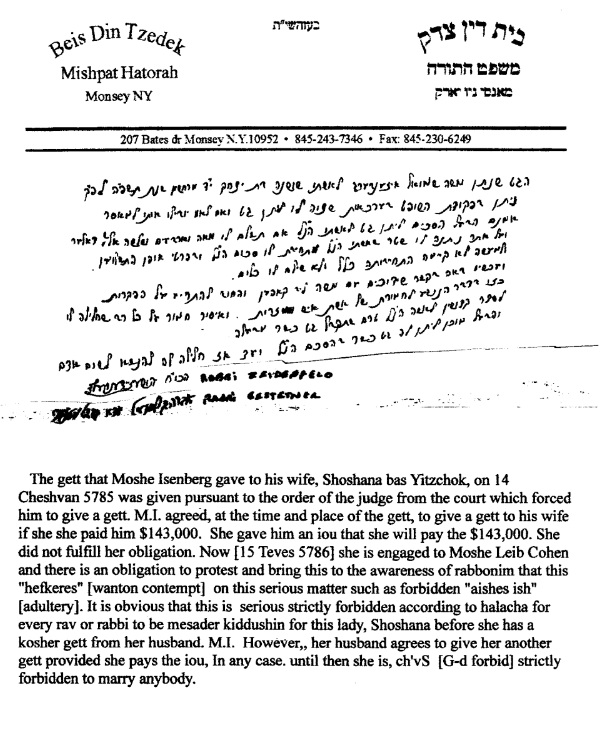
Gett of Moshe Isenberg to Shoshana Isenberg/Cohen is Posul פסלות הגט של משה איזנברג
PDF · 174 kB · 1/16/2026
 עברית
עברית English
תקציר בעברית
מסמך מבית דין 'משפט התורה' (מאנסי) המתאר את נסיבות הגט שנתן משה איזנברג לאשתו שושנה בת יצחק בכ"ד חשון תשפ"ה, אשר ניתן מחמת צו של בית משפט אזרחי שהכריחו לתת גט, ובתנאי שתשלם לו 143,000 דולר התחייבות שלא קוימה. המסמך טוען כי לאור זאת קמה חובת מחאה והתראה לרבנים שלא לסדר לה קידושין עד שיתבהר מעמדו ההלכתי של הגט, וכי לדעת הבעל הגט שניתן אינו גט כשר עד שתעמוד בתנאי. המסמך מובא כטענה הלכתית במחלוקת ואינו פוסק הלכה סופית.
English Summary
A document from the Beis Din Mishpat Hatorah (Monsey, NY) describing the circumstances of the get given by Moshe Isenberg to his wife Shoshana bas Yitzchok on 14 Cheshvan 5785, given under order of a secular court that compelled him to give it, conditioned on her paying him $143,000 — an obligation she did not fulfill. The document argues there is consequently a duty to alert rabbis not to perform kiddushin for her until the get's halachic status is clarified, contending (from the husband's side) that the get is not yet a valid get pending fulfillment of the condition. It is presented as one side's halachic claim in an ongoing dispute, not a final ruling.
Résumé en français
Ce document du tribunal rabbinique Mishpat HaTorah (Monsey) décrit les circonstances du guet donné par Moshé Isenberg à son épouse Shoshana bat Yitzhak le 24 hechvan 5785, délivré sur ordre d'un tribunal civil qui l'y avait contraint, à la condition qu'elle lui verse 143 000 dollars — engagement qui n'a pas été honoré. Le document soutient qu'il en découle un devoir d'avertir les rabbins de ne pas célébrer son mariage tant que le statut halakhique du guet n'est pas clarifié, estimant (du point de vue du mari) que le guet n'est pas encore valide tant que la condition n'est pas remplie. Le document est présenté comme l'argumentation halakhique d'une des parties dans un litige en cours, et non comme une décision halakhique définitive.