 עברית
עבריתתקציר בעברית
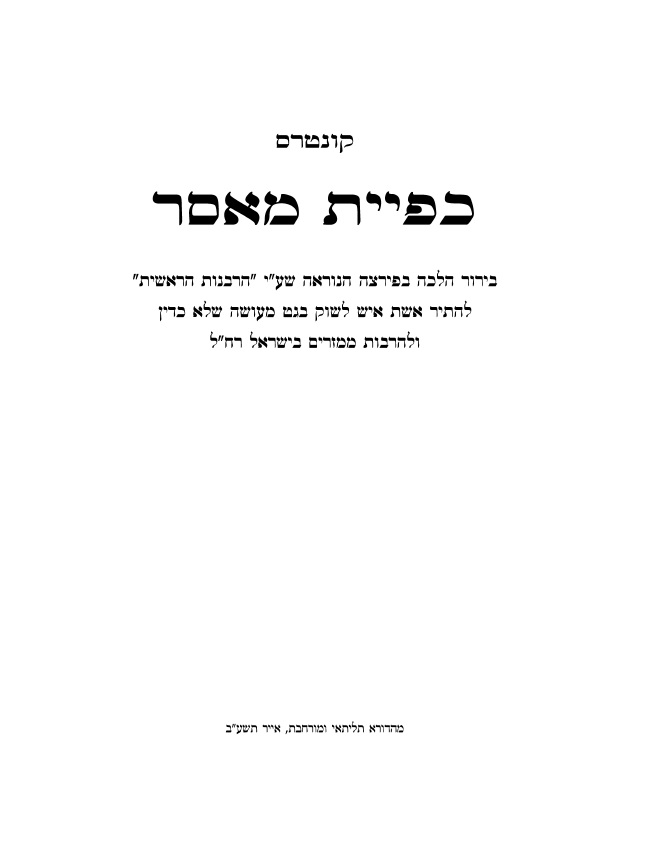
שו"ת בעניין פירצת הנוראה שע"י 'הרבנות הראשית' להתיר אשת איש לשוק בגט מעושה שלא כדין ולהרבות ממזרים בישראל ח"ו. ויתבאר בו 1) אם יש חרם של רבינו תם על המערער על גט בנימוקים ומקורות. 2) עד היכן אסרו הפוסקים כל כפייה על בעל שאינו מאותם שש של המשנה. 3) דאין החיוב של פריה ורביה מתיר בשום פנים ואפן הכפייה. 4) שאין שום חיוב או מצוה על בעל של מורדת לתת את הגט. 5) שביוש פומבי אינו בגדר הרחקה‚ רק כפייה גמורה הפוסל אף במי שחייב לגרש וקל וחומר במי שפטור מלגרש. 6) מחילת הכתובה אינה מהוה אישר של מכירת הגט. 7) פסלנות המוחלט של הגט מדין הפחדה ומדין מאסר. 8) אפילו חשש פסול בגט אינו מתיר לכוף על גט שני. 9) שאם עשו כפייה אפילו נגד דעת יחיד בפוסקים הגט פסול.
English Summary
A Responsum on the Israeli Rabbinate's Grave Breach in Permitting a Married Woman to Remarry through an Improperly Coerced Get, Thereby, God forbid, Increasing Mamzerut in Israel. The following issues are clarified: 1. Whether Rabbeinu Tam's ban (ḥerem) applies to one who challenges the validity of a get on halachic grounds. 2. The extent to which the halachic authorities prohibit every form of coercion against a husband who is not among the six categories in the Mishnah for whom coercion is permitted. 3. That the mitzvah of pru u'revu (be fruitful and multiply) never justifies coercion. 4. That there is no obligation or mitzvah for the husband of a moredet (rebellious wife) to give a get. 5. That public humiliation is not one of Rabbeinu Tam's harḥakot (distancing measures), but constitutes coercion that invalidates a get, even where the husband is obligated to divorce, and certainly where he is not. 6. That waiving the ketubah does not authorize the sale or purchase of a get. 7. The absolute invalidity of a get obtained through intimidation or imprisonment. 8. That even a doubt regarding the validity of a get does not justify coercing the husband to give a second get. 9. That if coercion was applied contrary even to the opinion of a single halachic authority, the get is invalid.
Résumé en français
Responsa sur les guittin obtenus par coercition et leurs conséquences halakhiques. 1) Absence de ḥerem de Rabbénou Tam contre celui qui conteste un guet sur des bases halakhiques. 2) Interdiction de toute contrainte envers un mari non visé par les cas prévus par la Michna. 3) La mitsva de procréer ne justifie jamais la contrainte. 4) Aucune obligation pour le mari d'une femme rebelle (moredet) de donner un guet. 5) L'humiliation publique est une contrainte, non une simple harḥaka, et invalide le guet. 6) La renonciation à la ketouba ne permet pas de monnayer le guet. 7) Un guet obtenu par intimidation ou emprisonnement est absolument invalide. 8) Un simple doute sur un guet n'autorise pas à imposer un second guet. 9) Toute contrainte contraire à l'avis d'un décisionnaire invalide le guet.